
The connected research workspace
AI that answers fromyour lab's actual work.
Every paper, protocol, result and note stays linked, so the assistant you ask has already read all of it, and cites what it used.
- Literature
- Protocols
- Experiments
- Data
- Writing
84%
of researchers already use AI in their work
Wiley ExplanAItions, 2025
7%
trust it enough to rely on for research decisions
Elsevier, Researcher of the Future, 2025
77%
of biologists have failed to reproduce another lab's experiment
Baker, Nature 533:452, 2016
The gap isn't capability. It's context. General models have never seen your data, so nothing they say can be checked.
The problem
Your work is already connected. Your tools are not.
Today
Four tools, none of which know about each other.
- Protocols live in a shared drive nobody trusts
- Results sit in spreadsheets on one laptop
- Why a condition was dropped is in someone's head
- Every AI conversation starts by re-explaining the project
With Notes9
One record, and an assistant that has read all of it.
- Protocols versioned, with the literature that justified them
- Data attached to the experiment that produced it
- Decisions recorded where the work happened
- Catalyst answers from your record, with citations
The chain
Every step writes a link to the last.
That chain is what makes an answer checkable, and what an ELN throws away.
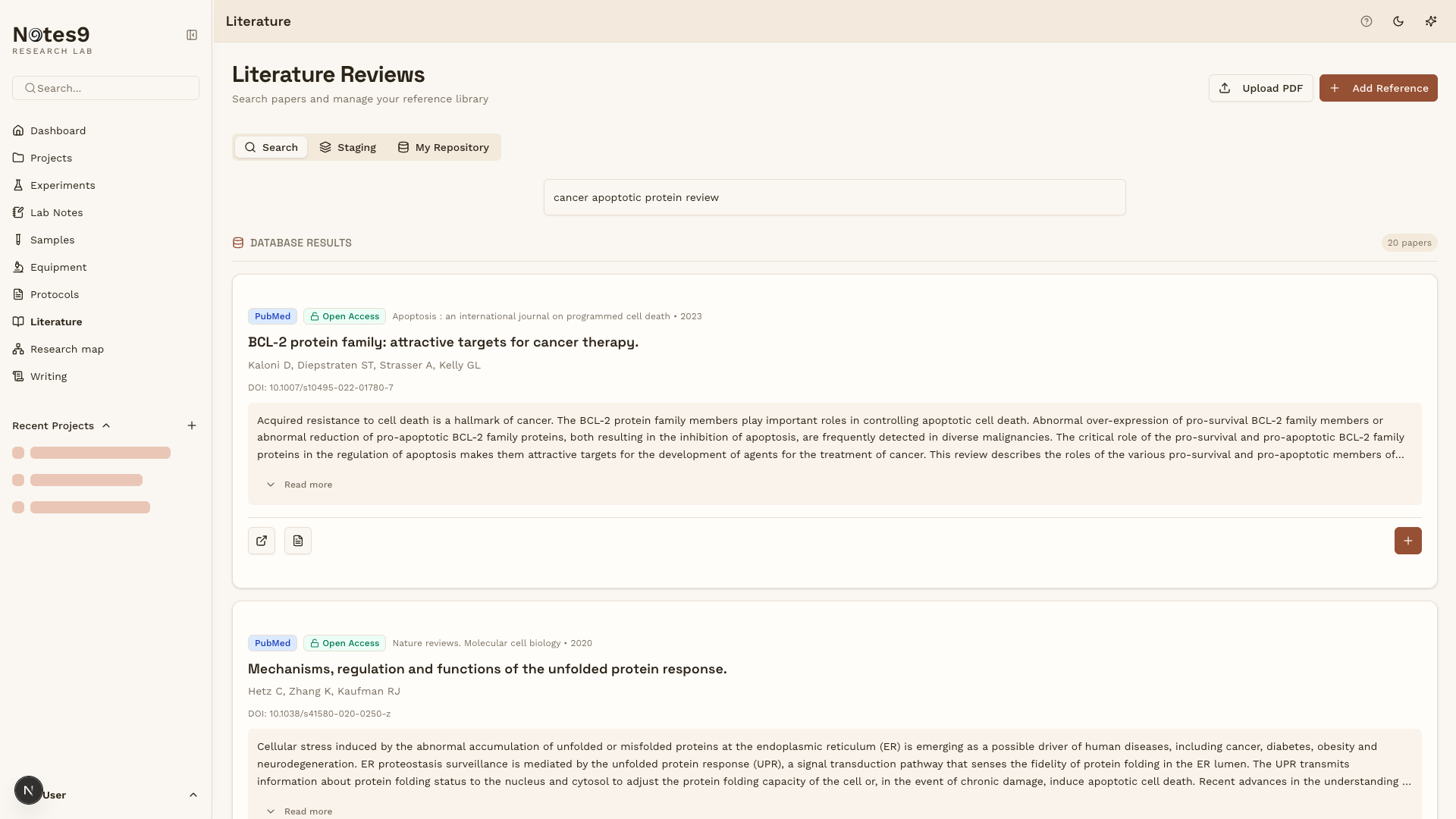
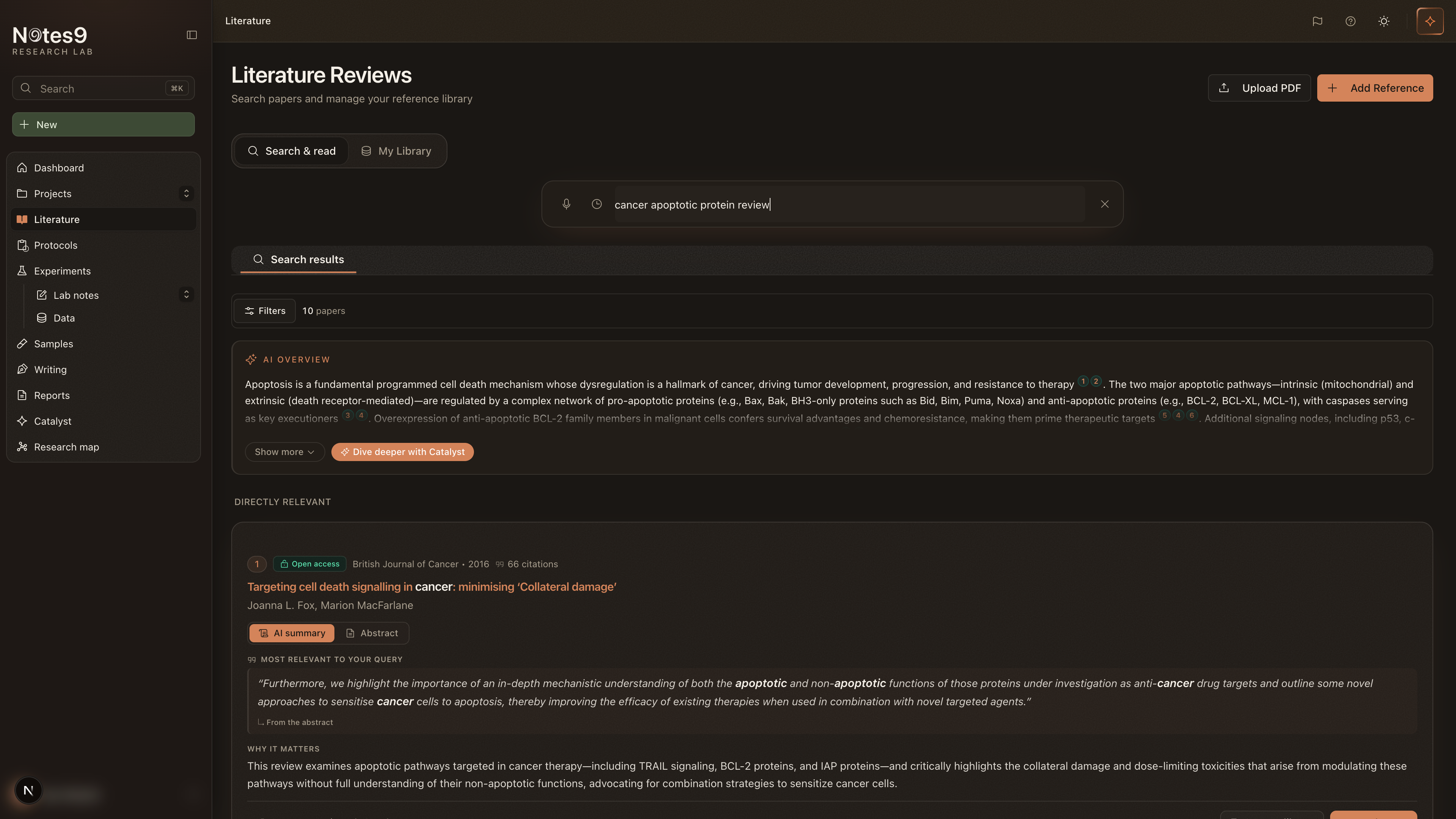
Ask a research question in plain language. Notes9 searches PubMed, Europe PMC and OpenAlex, summarises what comes back, and files the papers that matter with their PDFs attached.
Meet Catalyst
Not a search box. An assistant that has read your lab.
Catalyst answers from your projects, notes and saved papers, and cites the record behind every claim, so you can open the source instead of trusting the summary.
Ask it about your workAsked of a real project
“Why did we move to the 3:1 PEI ratio?”
Condition B (3:1) gave the highest transient yield in the ratio screen. Higher ratios raised cytotoxicity without improving yield, matching the ratio reported in the saved literature.
Get started
Your whole career, from first protocol to published paper.
Answer three questions and Notes9 sets up a workspace matched to your field, with a sample project you can pull apart to see how it fits together.
Or tell us what you are working on and how your group records it today, and we will show you how Notes9 would fit around it.
Book a workflow conversation
Tell us about your lab and where friction shows up today. Messages go to admin@notes9.com.